Author: Anton Friedrich Fischer
Part 1: In Four Waves?
In September 1901, the anarchist Leon Czolgosz shot the US President William McKinley at an exhibition in Buffalo. In response, his successor, Theodore Roosevelt, called for a worldwide crusade to wipe out the threat of terrorism. Exactly a hundred years later, after the attacks of 11 September 2001, George W. Bush again declared a war on terrorism that would not end until all terrorist groups had been defeated (Rapoport, 2004).
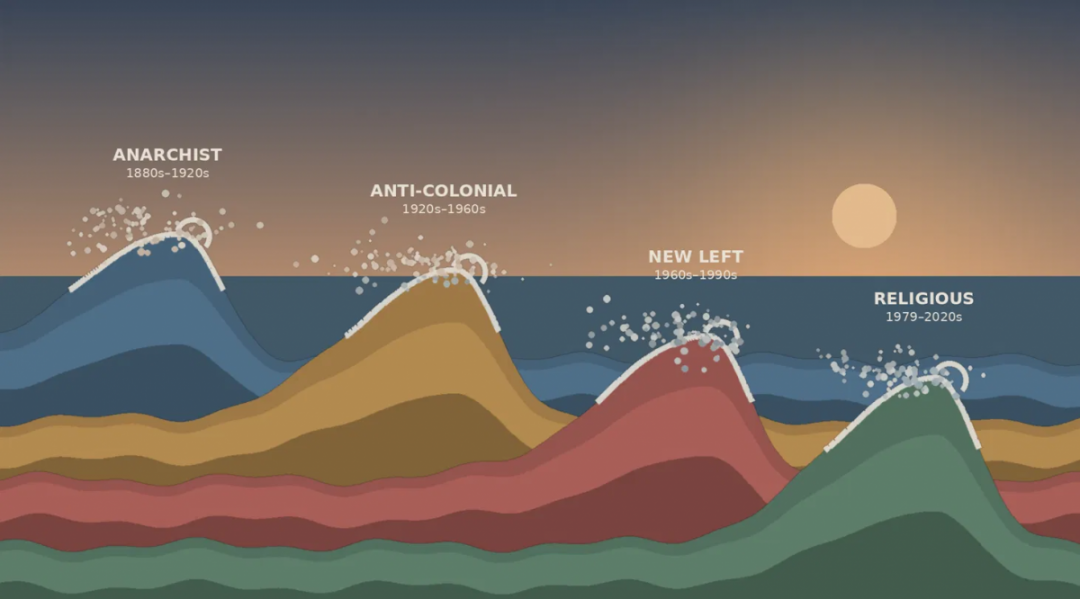
The political scientist David Rapoport opens his history of modern terrorism with this coincidence, and it captures his central idea. What appeared to be a new threat in 2001 was in fact the latest chapter of a story more than a century old. According to Rapoport, that story has a shape: Terrorism comes in waves, each lasting roughly a generation and each carried by a political idea that inspires groups in many countries at once.
Rapoport’s model has become the most widely used map for making sense of the history of modern terrorist violence, and I have used it myself in an earlier essay, where I followed three men’s journeys into political violence, each from a different era (Need, Narrative, Network: The Making of a Western Terrorist).
This essay is the first of three parts examining the history of terrorism. In this first part, I want to introduce Rapoport’s model. In the second (Part 2: In Four Strains?), I turn to two prominent critics of Rapoport, Tom Parker and Nick Sitter, who argue that modern terrorism did not come in waves but developed along four continuous strains. In the third and final part (Part 3: Strains That Come in Waves?), I try to show that both sides are right about different things and wrong about others.
First, a Word on What Terrorism Means
A reader encountering this history for the first time may stumble at an early point. Among Rapoport’s terrorist groups are the Irish Republican Army (IRA), the Irgun in British-ruled Palestine and the Algerian FLN. These groups were part of independence movements, with several of them helping to free their lands from colonial rule. Menachem Begin, who led the Irgun, later even went on to become prime minister of Israel and shared a Nobel Peace Prize. Calling such groups terrorists can sound like taking the side of the colonial powers they fought.
It is not, and the reason matters for everything that follows. As I argued in an earlier essay (Clarifying Key Terms: Ideology, Extremism, Terrorism, and Radicalization), terrorism is best defined by the specific method used rather than the goal pursued by a group. The Israeli scholar Boaz Ganor (2002) puts this most clearly. He starts from the law of war between states, which separates soldiers who fight enemy soldiers from war criminals who deliberately attack civilians. Ganor extends the same distinction to conflicts between a state and a non-state group. Terrorism, in his definition, is the deliberate use or threat of violence against civilians for political ends. The same violence aimed at soldiers or military targets, he calls guerrilla warfare (Ganor, 2002).
On this view, being a freedom fighter and being a terrorist are not necessarily mutually exclusive. “Freedom fighter” is usually the name groups give themselves to present their violence as legitimate and to explain what they are fighting for. “Terrorist” is a description of a method of fighting, namely, the deliberate use or threat of violence against civilians for political ends (see my essay Clarifying Key Terms: Ideology, Extremism, Terrorism, and Radicalization). For example, one can believe that Algerian independence was a just cause and still describe the bombing of cafés in Algiers as a terrorist act according to Ganor’s definition.
Rapoport’s wave theory builds on similar ground, specifically referencing the rules of war that protect bystanders and innocents. However, he defines terrorism more broadly (Rapoport, 2004). For him, what makes violence terrorism is primarily its communicative purpose: a terrorist act is executed above all to manipulate, intimidate, and strike fear into a watching audience. Second, terrorism is defined by its secrecy: while guerrillas fight openly as soldiers, terrorists hide their weapons and identities until they strike.
Consequently, an ambush on off-duty soldiers counts as terrorism under Rapoport’s definition if it is designed to send a message to a wider public. Similarly, even the assassination of a government minister (classified by Ganor as guerrilla warfare) counts as terrorism under Rapoport’s view if the attack is carried out covertly and designed to communicate a message to the public. Otherwise, the two definitions largely agree: both define terrorism by its methods rather than its goals, treat it as deliberate political violence, and emphasize the essential point that the label says nothing about whether a cause is just.
What Is a “Terrorist Wave,” and When Did Modern Terrorism Begin?
Rapoport’s subject is what he calls rebel terror: political violence by groups outside the state, directed against an established order (Rapoport, 2004). Within it, he sees a recurring historical pattern, which he calls a wave. A wave is a cycle of international activity that swells and ebbs over a distinct period. Similar groups emerge in many countries at once, driven by what Rapoport calls a “common predominant energy” (Rapoport, 2004, p. 47), something close to a revolutionary spirit of the age, which shapes their goals, tactics, and relations with one another.
That energy is rooted in hope, which, in Rapoport’s words, serves as “an indispensable lubricant of rebel activity” (Rapoport, 2004, p. 51). It is typically sparked by a major political upheaval that suddenly exposes an established order as vulnerable, convincing small groups that a few determined individuals can bring it down. According to Rapoport, each wave lasts roughly a generation, or about forty years. He links this wave cycle to the human life cycle: the ideals that inspire parents often lose their appeal for their children, and once a wave fails to mobilize new organizations, it fades away (Rapoport, 2004).
Before exploring these waves, however, one may ask: when and why did modern terrorism begin? For Rapoport, two ingredients triggered the emergence of modern waves of terrorism in the last quarter of the nineteenth century (Rapoport, 2004). One was a revolution in communications and transport. The telegraph, the mass-circulation newspaper and the railway meant that a single attack could draw attention far beyond its own country within a day, and that agitators could travel quickly.
The other was ideology, which gave modern terrorism its theoretical foundation. Its roots lay in the French Revolution, which had spread egalitarian and national ideals across Europe and given the word terror its political meaning (Rapoport, 2004, 2016). The turning point came in Russia. What turned these ideals into a strategy of political violence by small groups was disappointment: in the 1870s, young Russian radicals had gone to the countryside to win over the peasantry for a socialist revolution through peaceful persuasion, but failed (Rapoport, 2016). In response to this failure, Russian revolutionaries developed a strategy that later groups could study, improve and pass on (Rapoport, 2004). Their leading figure was Sergei Nechaev, a young radical whose Catechism of a Revolutionary portrayed the revolutionary as a man without ties, feelings or morals. The core of the doctrine was a simple calculation: repeated dramatic attacks would force governments to respond in ways that broke their own rules. This, in turn, would polarize society and bring revolution closer. (Rapoport, 2004).
From these beginnings, Rapoport tells the history of modern terrorism down to the present as a sequence of four waves. Each was carried by the hopes of one generation, a small part of which turned to political violence in general and terrorist methods in particular, either because those hopes were disappointed or because dramatic success made revolution seem within reach.
Rapoport’s Four Waves
The Anarchist Wave (1880s–1920s)
The first wave grew directly out of the Russian situation just described. Tsar Alexander II had freed the serfs in 1861 and promised sweeping reforms. When these promises were not kept fast enough, and radical reformers failed to win over the peasantry, disappointment turned into violence (Rapoport, 2004). One scene captures that: in 1878, Vera Zasulich shot and wounded a St. Petersburg police chief who had abused political prisoners, threw down her pistol, and declared herself a “terrorist, not a killer” (Rapoport, 2004, p. 50). A jury acquitted her, and the crowd outside cheered.
At the heart of this movement was the belief that a dramatic act, carried out at real personal risk, would spread a political message far better than any pamphlet, a concept that became known as “propaganda of the deed”. What transformed these events into the first wave of modern terrorism was the rapid international adoption of this strategy: armed with the newly invented dynamite, radicals across industrialized countries turned powerful state leaders into their primary targets (Rapoport, 2004).
The wave reached its high point in the 1890s, a period that became known as the “golden age of assassination”: a French president, a Spanish prime minister, an Austrian empress and an Italian king were all killed within six years (Rapoport, 2004). In 1901, the wave also reached the United States, where President William McKinley was shot, as described at the beginning of this essay.
At this time, the rebels themselves were the only ones to call these assassinations terrorism, and they did so with pride. By Ganor’s definition, however, most of these killings, targeting heads of state and government rather than civilians, would count as guerrilla warfare. For Rapoport, however, these attacks fall under his definition of terrorism: political violence against public figures, carried out to influence and strike fear into a watching audience. This first wave of anarchist assassinations faded after 1914, when another assassination in Sarajevo helped spark the First World War.
The Anti-Colonial Wave (1920s–1960s)
The event that set off the second wave was the peace settlement signed at Versailles in 1919, after the First World War. There, the victorious powers declared that every nation had the right to govern itself, yet they applied this principle only to the defeated empires, not to their own. As a result, in the colonies of the victorious powers, hopes were raised and then frustrated: Britain held on to Ireland and Cyprus and even took over Palestine as a League of Nations mandate, while France kept Algeria (Rapoport, 2004). This made the victorious empires appear hypocritical, and in these very places, independence movements sooner or later took up arms.
The anarchists had shown that killing leaders could backfire: the murder of a tsar had brought harsher repression, not revolution, and the shots at Sarajevo had helped unleash a world war. The rebels of the second wave therefore chose a different target: the police, whom Rapoport calls the government’s “eyes and ears” (Rapoport, 2004, p. 54). Without them, the state would have to send in soldiers. The rebels expected the following chain of events: the soldiers would respond with violence against the population, and that brutality would convince ordinary people that the rebels had no alternative to violence, winning their support. On Ganor’s definition, the attacks on the police would count as guerrilla warfare. But most of these groups also struck civilians, as the Algerian Front de Libération Nationale (FLN) did when it planted bombs in the cafés of Algiers in 1956, so by Ganor’s measure the wave was a mixture of the two (Ganor, 2002).
What set this wave apart – both from the anarchist wave that preceded it and from the subsequent waves – was its success. Violent campaigns directly contributed to the establishment of the Irish Free State in 1922, the creation of Israel in 1948, Cypriot independence in 1960, and Algerian independence in 1962 (Rapoport, 2004). Rapoport explains this unique success by mentioning that the colonial powers were themselves ambivalent about maintaining colonial rule in these countries. Having proclaimed self-determination as a major war aim, part of their own populations increasingly sympathized with the anti-colonial causes (though seldom their methods). In addition, the United States, now the dominant Western power, also pushed other Western states towards decolonization. For governments still recovering from the devastation of the Second World War, the prospect of a prolonged, costly conflict was often enough to tip the balance (Rapoport, 2004, 2022).
Beyond these geopolitical reasons, the rebels also helped their cause by deliberately changing their political language (Rapoport, 2016). The Jewish group Lehi, fighting British rule in Palestine, was the last organization to openly embrace the label “terrorist”. In contrast, Menachem Begin, leader of the rival group Irgun, reframed his members as freedom fighters resisting “state-sponsored terror”, a rhetorical shift that nearly every subsequent revolutionary movement would adopt (Rapoport, 2004).
The New Left Wave (1960s–1990s)
The third wave was triggered primarily by the Vietnam War. That a small, developing nation could successfully hold off the United States suggested to radical movements that the Western system was ultimately vulnerable (Rapoport, 2004). In the West itself, the war stirred up “enormous ambivalence” among young people about the existing system (Rapoport, 2004, p. 56), as American atrocities such as the My Lai massacre came to light (Rapoport, 2022). Radical groups subsequently emerged in the heart of the West, including the Red Army Faction in West Germany (whose co-founder Andreas Baader was examined in an earlier essay: Need, Narrative, Network: The Making of a Western Terrorist), the Red Brigades in Italy, and the Weather Underground in the United States. These movements viewed themselves as the vanguard of the Global South’s oppressed masses, with the Palestine Liberation Organization (PLO) serving as their primary model and training ground, particularly after 1975.
Their signature tactics were aircraft hijackings, occurring roughly seven hundred times over three decades, as well as international hostage-taking (Rapoport, 2004). Here, Ganor’s and Rapoport’s definitions agree. Airline passengers and kidnapped executives are civilians for Ganor, and for Rapoport they were “theatrical targets” (Rapoport, 2004, p. 56), chosen to hold the attention of a mass audience in front of their TVs.
One distinctive feature of this wave was the social background of its participants. Its members were typically in their twenties, predominantly from middle- and upper-class backgrounds, and two-thirds had some university education (Rapoport, 2022). Separatist groups were the partial exception. The Provisional IRA, for instance, recruited largely among poorer Catholics, and separatists such as ETA were less educated (Rapoport, 2022). Furthermore, women, who had mostly served as scouts and messengers in the anti-colonial wave, became central figures once more, as they had been in the anarchist wave (Rapoport, 2004). Within Western democracies, third-wave organizations remained small groups with little public support for their political violence (Rapoport, 2022). The wave ultimately ebbed in the 1980s and 1990s as state countermeasures dismantled group after group (Rapoport, 2004).
The Religious Wave (1979–2020s)
According to Rapoport, a fourth wave began in 1979, a pivotal year that appeared to demonstrate the political power of religion. In Iran, a revolution under religious leadership toppled the Shah, a secular monarch whom Iranian Marxist groups had been unable to challenge for decades. In Mecca, armed militants led by a self-proclaimed Mahdi, the redeemer some Muslims expect at the turn of an Islamic century, seized the Grand Mosque. In December of the same year, the Soviet Union invaded Afghanistan, drawing volunteers from across the Sunni world to fight alongside the Afghan resistance. Backed by American aid, the resistance forced the Soviet army to withdraw by 1989 (Rapoport, 2004, 2016). Taken together, these events suggested to some believers in the region that religious faith had succeeded where the secular doctrines of the third wave had failed.
Osama bin Laden founded the wave’s best-known organization, al-Qaeda, in 1988, as the Afghan war drew to a close. Its first members were foreign volunteers who had fought there. The wave’s signature tactic, suicide bombing, had already been introduced in the early 1980s by Shia militants in Lebanon (Rapoport, 2004). From Ganor’s perspective, this wave encompasses both guerrilla warfare and terrorism: targeted strikes on military personnel, such as the suicide bombings that drove American forces out of Lebanon, alongside indiscriminate violence against civilians, most notably the attacks of 11 September.
What fundamentally set this wave apart from the previous ones was the nature of its ultimate objective. While religion had influenced earlier conflicts (such as those in Ireland, Cyprus, or Palestine), it had primarily reinforced nationalist causes aimed at creating secular nation-states. In the fourth wave, religion itself provided both the moral justification and the blueprint for the future political order (Rapoport, 2004). The wave also produced fewer groups than previous waves, but they proved larger and more resilient, and individual organizations became more transnational (Rapoport, 2004, 2016). Al-Qaeda, for example, drew its recruits from dozens of countries (Rapoport, 2004).
Islamic movements stood at the center of this wave, but it was not exclusive to Islam: Rapoport also includes Sikh militants in the Punjab, Jewish extremists in Israel, the Japanese cult Aum Shinrikyo, and the American Christian Identity movement (Rapoport, 2004). If the pattern of the earlier waves held, Rapoport predicted that this religious wave should fade around 2025, a forecast I return to in the third essay of this series (Part 3: Strains That Come in Waves?).
What the Waves Leave Out
The largest gap in Rapoport’s wave theory is right-wing terrorism: violence by groups that set out to subordinate, expel or eliminate another part of the population, from the Ku Klux Klan’s terror against freed slaves to the attacks on two mosques in Christchurch in 2019 (Need, Narrative, Network: The Making of a Western Terrorist). Such violence runs through the whole period Rapoport covers, yet it is almost entirely missing from his four waves.
To be fair, Rapoport leaves this kind of right-wing terror out by choice. In a footnote, he explains that he sets right-wing groups aside because they are usually tied to government reactions rather than rebel terror directed against governments (Rapoport, 2004). His reasoning holds only in part. Many right-wing terrorists have turned on their own states: Timothy McVeigh bombed a federal building in Oklahoma City in 1995, while Anders Breivik attacked the seat of the Norwegian government in 2011. Rapoport can place some of these cases by stretching his religious wave: he counts the Oklahoma City bombing as part of it (Rapoport, 2004), although McVeigh was driven less by faith than by hatred of the federal government. Rapoport himself later wondered, after the storming of the US Capitol, whether a fifth, far-right wave had begun, only to reject the idea a year later (Rapoport, 2021; Millington, 2024). I return to this gap, and to other weaknesses of the model, in the next two essays.
The appeal of the model is readily apparent. It turns more than a century of seemingly random terrorism into a story with four chapters, each with its own cause and methods, and it offers a forecast that can be checked. But its gaps are where its critics begin. A prominent alternative comes from Tom Parker and Nick Sitter (2016): not four successive waves but four strains of terrorism that have run side by side since the 1850s, one of which, social exclusion, covers right-wing violence. They also ask a question that a story told in chapters invites: does anything carry over from one chapter to the next? Their model and their answer are the subject of the second part (Part 2: In Four Strains?).
References
Ganor, B. (2002). Defining terrorism: Is one man’s terrorist another man’s freedom fighter? Police Practice and Research, 3(4), 287–304. https://doi.org/10.1080/1561426022000032060
Millington, C. (2024). Bad history: A historian’s critique of Rapoport’s “four waves of modern terrorism” model. Critical Studies on Terrorism, 17(3), 488–505. https://doi.org/10.1080/17539153.2024.2360266
Rapoport, D. C. (2004). The four waves of modern terrorism. In A. K. Cronin & J. M. Ludes (Eds.), Attacking terrorism: Elements of a grand strategy (pp. 46–73). Georgetown University Press.
Rapoport, D. C. (2016). It is waves, not strains. Terrorism and Political Violence, 28(2), 217–224. https://doi.org/10.1080/09546553.2015.1112278
Rapoport, D. C. (2021). The Capitol attack and the 5th terrorism wave. Terrorism and Political Violence, 33(5), 912–916. https://doi.org/10.1080/09546553.2021.1932338
Rapoport, D. C. (2022). Waves of global terrorism: From 1879 to the present. Columbia University Press.
Parker, T., & Sitter, N. (2016). The four horsemen of terrorism: It’s not waves, it’s strains. Terrorism and Political Violence, 28(2), 197–216. https://doi.org/10.1080/09546553.2015.1112277